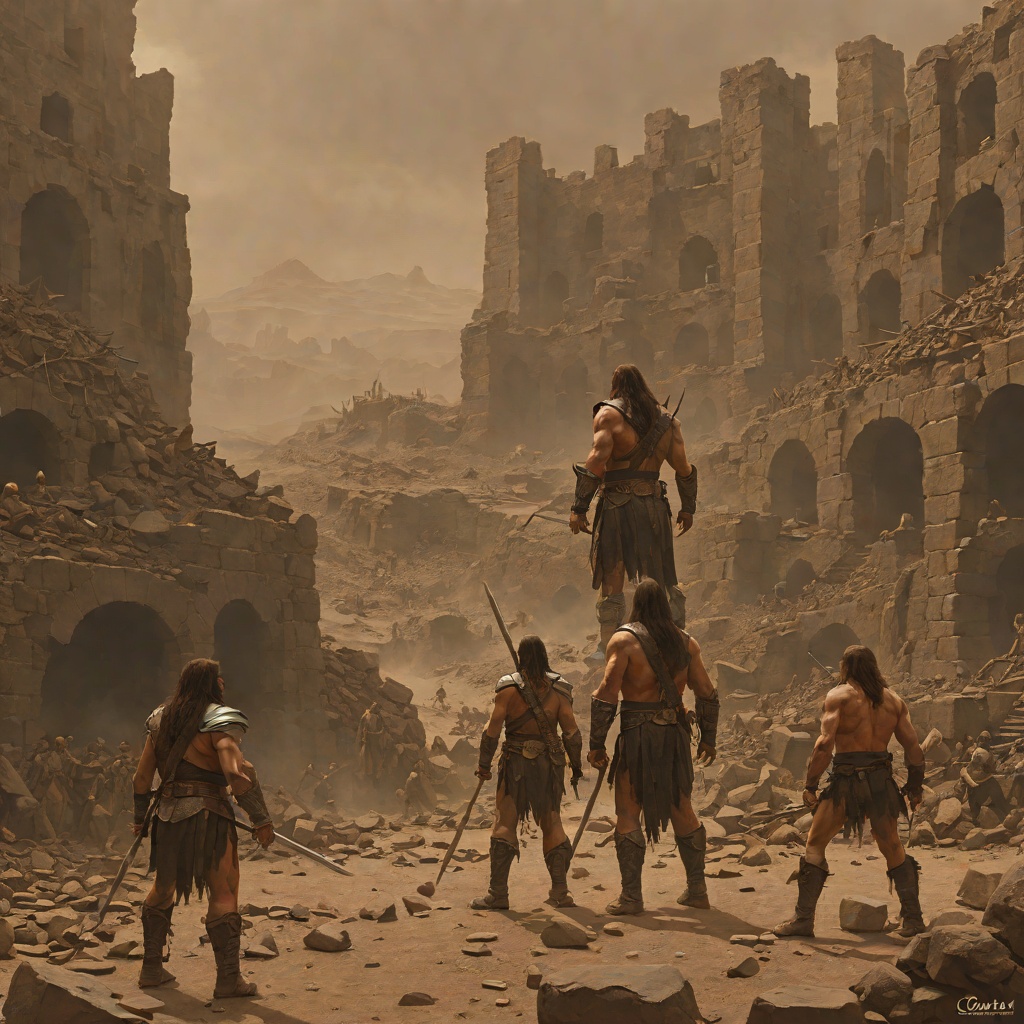
A blade of well-forged steel is the only thing a man can count on
Conan the BarbarianA blade of well-forged steel is the only thing a man can count on is the foundational creed of the Conan saga, a maxim uttered by Corin the smith to his young son on a night of lightning and storm. It is the seed from which the entire philosophy of the Cimmerian warrior grows, the first lesson in the 'riddle of steel' that Conan must master before he is worthy to bear a sword. The phrase, and the complex of ideas it represents, travels with Conan from his boyhood in a snowbound village to the throne of Aquilonia, and it is ultimately tested, challenged, and redefined in his final confrontation with the sorcerer Thulsa Doom. More than a piece of advice, it is the moral and metaphysical heart of the story, the answer to the question of what a man can truly rely upon in a world of gods, demons, and treacherous men.
The Father's Lesson and the Riddle of Steel
The maxim is first delivered in the smithy of Corin, a man who came out of the south lands bearing the arcane secret of steel, a precious inheritance from the ancient Atlanteans believed lost to the world. On the night of its forging, as the anvil rang like a bronzen bell and fountains of sparks rose and fell, Corin told his son that before a man is worthy to bear a sword of steel in battle—a weapon such as the gods once bore against the giants—he must learn its riddle. He warned the boy that in all the world he could trust no one, neither man nor woman nor beast, neither spirit nor demon nor god, but that he could trust a blade of well-forged steel. This was not merely practical advice but a profound statement of a worldview: in a universe of capricious deities and faithless mortals, the only reliable companion is a thing of tempered metal, an object that will not betray.
Corin expanded this lesson into a complete philosophy of self-forging. He cupped his son's small hands within his own and, curling the boy's fingers about the hilt of the great sword, explained that the heart of a man is like a piece of unworked iron. It must be hammered by adversity and forged by suffering and the challenges flung by the thoughtless gods, nigh unto the point of breaking. It must be purged and hardened in the fires of conflict, purified and shaped on the anvil of despair and loss. Only when the heart has become as steel, he said, will a man be worthy to wield a keen-edged sword in battle and win against his enemies, as did the gods when they conquered the dark giants. The lesson was that the blade is a symbol and a test: to master steel, one must first become steel. All his life, Conan remembered those words, and in time he began to comprehend the cryptic phrases, understanding that out of suffering is born strength, and only through pain and deprivation does a human heart become as strong as steel.
The Maxim in the World of Men
The creed of steel is not confined to the father's smithy; it is tested and echoed throughout Conan's journey through the Hyborian Age. When Conan, now a Pit fighter in the lands of the Nordheimers, dismisses a sword as "not much of a sword," his trainer Uldin, a forger of men, challenges the maxim's literal meaning. Conan proudly repeats his father's words, declaring that a blade of well-forged steel is the only thing in the world a man can count on. Uldin grunts in reply, offering a counter-creed: the real measure of a man lies not in the steel he carries, but in himself. In a manner of speaking, it is the man who is forged, not the blade. This exchange sets up the central tension of the story: is the power in the object, or in the subject? Uldin's philosophy, born of his role as a trainer of slaves, insists that the human spirit is the ultimate weapon, a lesson that Conan will only fully grasp at the climax of his quest.
The maxim also stands in stark contrast to the philosophy of Thulsa Doom, the cult leader who destroyed Conan's village. Doom's power is not in steel but in the mind, in the hypnotic control he exerts over his followers. In his garden, he demonstrates this power with horrifying clarity, commanding a young girl to leap to her death to prove the strength of his will. As the broken body lies at their feet, Doom sneers at the very concept of steel, asking what is steel compared to the hand that wields it, and what is the hand without a mind to command it. He declares this to be the secret of strength, dismissing steel with a contemptuous "Steel, bah!" This is the direct antithesis of Corin's creed: where the father taught that steel is the only thing a man can count on, Doom teaches that the will is supreme and that steel is a crutch for the weak. Conan, however, is unimpressed, staring dourly and accusing Doom of having power only over fools and weaklings, never having met a real man on equal terms.
The Reforging of the Creed
The final and most profound transformation of the maxim occurs in the great temple of Set, after Conan has slain the great serpent and beheaded Thulsa Doom. Watching the severed head roll down the long flight of stairs to rest beside the fountain pool, Conan speaks half to himself, reconciling the two poles of his life. He acknowledges that his father was the light of day and Thulsa Doom his night, yet in one thing the sorcerer spoke true. The crucial insight is that what matters is not the steel within the blade, but the steel within the man. This is not a rejection of his father's teaching but its ultimate fulfillment. Corin's lesson was never about the physical object itself; it was about the process of becoming as strong and reliable as that object. The blade was a metaphor for the self, and Conan, having been hammered by adversity, forged by suffering, and hardened in the fires of conflict, has finally become the steel his father spoke of. He has internalized the maxim so completely that the external object is no longer necessary; he is the blade.
This redefinition is the culmination of Conan's entire arc. The boy who was told he could trust only a blade of well-forged steel becomes a man who embodies that steel. The maxim, which began as a father's warning about the untrustworthiness of the world, ends as a testament to the strength of the individual will. It is the answer to the riddle of steel, the secret that Doom, for all his power over minds, could never understand. Doom believed the hand was nothing without the mind, but Conan proves that the mind is nothing without the steel of the spirit to command it. In this final synthesis, the creed of the father and the challenge of the enemy are fused into a single, triumphant philosophy: the only thing a man can truly count on is the strength he has forged within himself.